

Craps Table Layout Explained for Beginners: A Complete Guide

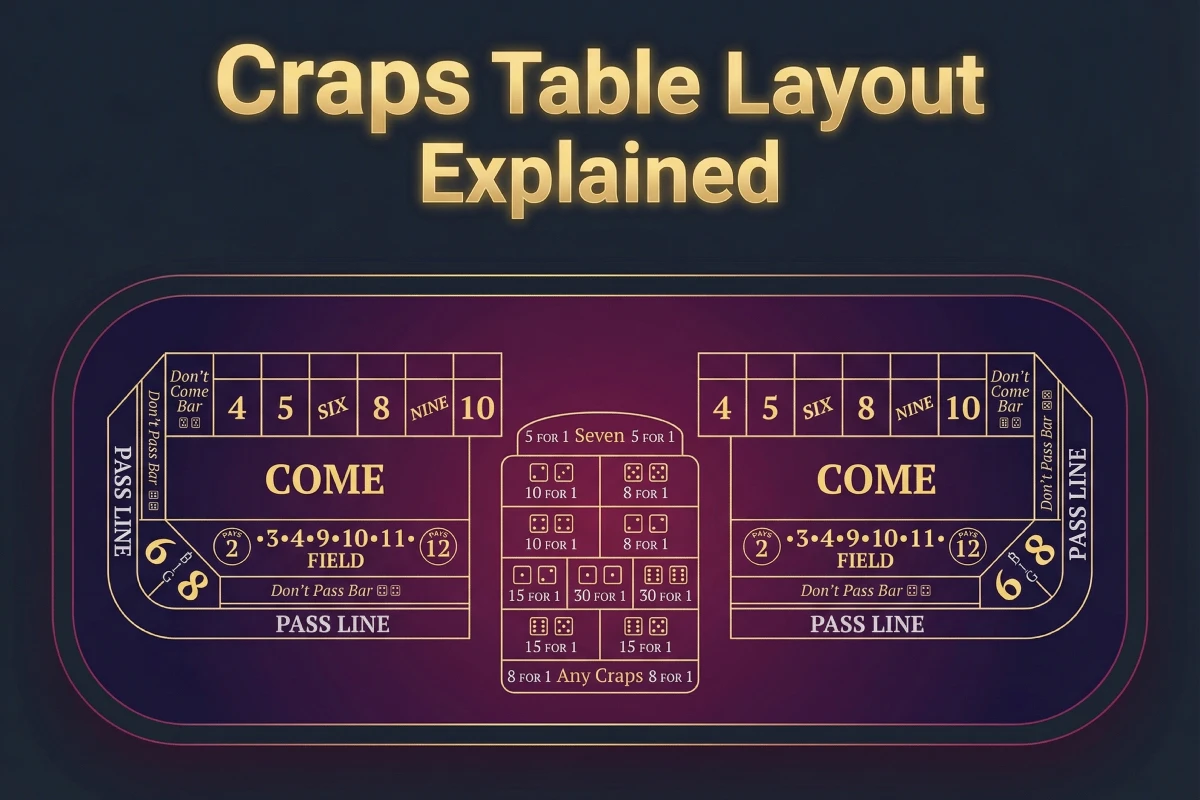
Stand next to a craps table for a minute and just watch. Don’t play, just watch. At first, it looks like noise. Chips flying around, people reacting too loudly for what seems like two small dice, dealers moving with the kind of speed that suggests they’ve done this a thousand times before. And the table itself does not help much. Numbers everywhere, boxes inside boxes, labels that sound like instructions but do not explain anything.
- What Is a Craps Table Layout and How Does It Work?
- Understanding the Flow of the Game Before the Layout
- Come-Out Roll Outcomes
- The Pass Line: The Safest Place to Start
- The Don’t Pass Line: A Different Way to Play
- Come Bets: Extending the Game Beyond the First Roll
- The Number Boxes: Where the Core Action Happens
- The Field Bet: Fast, Simple, and Tempting
- Proposition Bets: The Center of Risk
- Hardways Bets: A More Specific Prediction
- Odds Bets: The Most Important Hidden Area on the Table
- Understanding Craps Probability and Why It Matters
- Core Craps Areas at a Glance
- Final Tips for Beginners Learning the Craps Table Layout
- And Then… It Just Clicks!
Most beginners have the same thought at this point: this is way too much. Fair enough. It does look like too much. That is exactly why step-by-step guides to casino games exist. Some games really are difficult to understand at first.
But here is the part that usually gets missed: the table is not complicated in the way it seems. It is layered. That is different. Once you stop trying to read everything at once and instead follow the logic underneath, things begin to line up.
Craps is a dice game, and when stripped down to its core, it is not dramatic at all. Two dice are rolled. Players bet on what happens next. That is the whole story. The table simply makes room for all the different ways people can respond to that roll.
This guide is not going to throw everything at you at once. That would defeat the purpose. Instead, we will move through the table the way a player actually experiences it, piece by piece, the same way it slowly starts to make sense in real life.
The craps table is not as complicated as it first appears. It is layered, and once you understand the flow of the game, the layout starts to make sense.
What Is a Craps Table Layout and How Does It Work?
The felt on the table is doing more work than it gets credit for.
Every marking you see is there because, at some point, someone needed a place to put chips without causing confusion. That is really the origin of the layout. Not decoration, and not design for its own sake, but organization under pressure.
If you take a step back, the table is not one surface. It is more like a set of neighborhoods.
Along the edges, things are calmer. This is where the main bets sit, the ones most players stick with. Move inward and you start seeing more options, more specific bets, and a bit more risk. Dead center is where things get more ambitious: higher payouts, lower chances, and quicker decisions.
There is also symmetry. Both sides mirror each other, which is less about appearance and more about practicality. Casinos want many players at the same table, and this setup allows that without turning the game into a struggle for space.
What matters most is how smoothly everything runs. Multiple players can place bets at the same time without interfering with one another. Dealers know exactly where to look, where to place chips, and where to pay out.
Speed matters in craps, and the layout quietly makes that possible.
At some point, you stop seeing random boxes and start noticing that everything has a place. That is usually the moment when things begin to settle.
Understanding the Flow of the Game Before the Layout
A common mistake is trying to memorize the table before understanding how craps actually works. That approach usually fails.
Craps moves in a rhythm. Once you catch that rhythm, the layout starts to feel like a map instead of a wall of information.
Everything begins with the come-out roll, the first roll of the round.
Come-Out Roll Outcomes
| Roll Result | What Happens | Game Effect |
| 7 or 11 | Certain bets win immediately | Round resolves right away |
| 2, 3, or 12 | Certain bets lose immediately | Round resolves right away |
| 4, 5, 6, 8, 9, or 10 | That number becomes the point | Round continues until the point or 7 appears |
If a point is established, the game shifts gears. Now the goal is to roll that same number again before a 7 appears.
Hit the point again and you win. If a 7 shows up first, you lose.
This simple loop is what the entire table is built around. Some sections matter on the come-out roll. Others only matter after a point exists. Once you see that split, the layout stops feeling random.
Once you catch the rhythm of the game, the layout starts to feel like a map instead of a wall of information.
The Pass Line: The Safest Place to Start
If you are unsure where to begin, the Pass Line bet is the obvious answer. Not because it is exciting, but because it is clear.
It sits along the edge of the table, easy to reach and easy to spot. Dealers point to it for a reason.
When you place a bet here, you are aligning yourself with the basic flow of the game. You are betting that things will go the “normal” way.
On the come-out roll:
- A roll of 7 or 11 wins.
- A roll of 2, 3, or 12 loses.
If a point is established:
- You win if the point is rolled again.
- You lose if a 7 appears first.
There are no hidden tricks here.
It is also one of the few bets that does not work against you too aggressively. The house still has an edge, of course, but compared with many other options on the table, this one is relatively reasonable.
A lot of players never really move far from the Pass Line, and honestly, that is not a bad thing.
For most beginners, the Pass Line is the clearest and most practical place to start.
The Don’t Pass Line: A Different Way to Play
Right next to the Pass Line is its less popular sibling, the Don’t Pass Line. It follows the same structure, but with the outcomes reversed.
You are betting against the shooter instead of with them. When others win, you lose. When they lose, you win.
Mathematically, it makes perfect sense. Socially, it can feel a little strange. You may find yourself quietly benefiting from outcomes that disappoint everyone else.
Some players ignore this area entirely. Others prefer it because of the odds. Either way, its presence adds balance to the game. You are not forced into just one way of thinking.
Come Bets: Extending the Game Beyond the First Roll
Once a point is set, you might expect the game to narrow down. Instead, it opens up.
Come bets let you jump in again even though the round is already in motion.
They sit just inside the Pass Line area, and they behave like a fresh start. The next roll becomes a mini come-out roll for that bet.
If a number shows up, that becomes its own point. Now you can have multiple bets running at the same time, each tied to different outcomes.
It sounds messy, but it is not. It just takes a moment to get used to the idea that craps allows overlapping bets. That flexibility is part of what keeps the game engaging.
The Number Boxes: Where the Core Action Happens
In the middle of the table, you will see a row of familiar numbers: 4, 5, 6, 8, 9, and 10.
These are not random picks. These are the numbers that can become the point, and they also support Place bets.
A Place bet is simple in concept. You pick one of those numbers and bet that it will show up before a 7 does.
That is all you are saying.
Of course, not all numbers behave the same. Some appear more often than others, which is why payouts differ. Visually, though, these boxes form the center of gravity for the game. A lot of the action ends up here.
The Field Bet: Fast, Simple, and Tempting
The Field is one of the most visually noticeable sections of the table. It is large, clearly labeled, and promises fast outcomes.
One roll decides everything.
If the dice land on 2, 3, 4, 9, 10, 11, or 12, you win. Anything else and you lose.
It feels approachable because it does not require patience. No waiting for a point and no long sequences.
But there is a trade-off. The simplicity comes with a higher long-term cost. The house edge here is not as friendly. Still, for learning the table, it is a useful stop along the way.
Proposition Bets: The Center of Risk
If you look at the very center of the table, you will find a section filled with smaller betting options. These are known as proposition bets.
They are one-roll bets on specific outcomes, and they usually come with higher payouts.
You can bet on exact totals like 2, 7, 11, or 12. The rewards can look attractive, especially compared with the steadier bets around the edges.
But there is a reason these bets are grouped together, slightly removed from everything else. They are riskier, much riskier.
The table does not say that out loud, but the placement hints at it.
Hardways Bets: A More Specific Prediction
Near the proposition bets, you will find the Hardways section. These bets are about precision. You are not just calling a number; you are calling the exact combination.
To win a Hardways bet, the number must be rolled as a pair:
- Hard 4 (2 and 2)
- Hard 6 (3 and 3)
- Hard 8 (4 and 4)
- Hard 10 (5 and 5)
If the number appears in any other combination, or if a 7 is rolled first, the bet loses.
It adds a layer of detail that some players enjoy, but it is not where most beginners spend their time.
Odds Bets: The Most Important Hidden Area on the Table
One of the most valuable things a beginner can learn is how odds bets work.
You will not see a clearly marked section for these bets. Instead, they are placed directly behind your Pass Line bet once a point has been established.
What makes them important is simple: they are paid based on true craps probability, with no additional house edge on that portion of the bet.
That makes them rare in a casino setting.
They do not replace your original bet. They sit behind it and strengthen it quietly, without drawing much attention.
Odds bets are one of the few places in a casino game where the payout is based on true probability rather than an added house edge.
Understanding Craps Probability and Why It Matters
Even if you are not a fan of numbers, they are always working in the background.
With two dice, there are 36 possible combinations, and some totals appear more often than others.
That imbalance shapes the entire table. It explains why some bets feel easier to win and why others pay more when they do.
The Pass Line, for example, wins just under half the time, roughly 49%. That balance is not accidental.
You do not need to memorize probabilities, but knowing they exist helps everything else make more sense.
Core Craps Areas at a Glance
| Table Area | Main Purpose | Beginner-Friendly? |
| Pass Line | Basic bet following the normal flow of the game | Yes |
| Don’t Pass | Betting against the shooter | Moderately |
| Come Bets | Adding new bets after a point is set | Moderately |
| Number Boxes / Place Bets | Betting that a number appears before 7 | Yes, with basic guidance |
| Field | One-roll bet on several totals | Simple, but less favorable |
| Proposition Bets | One-roll bets on exact outcomes | Not recommended |
| Hardways | Betting on exact doubles | Usually later |
| Odds Bets | Enhancing Pass Line or Don’t Pass bets with true odds | Yes, after basics are clear |
Final Tips for Beginners Learning the Craps Table Layout
If you are new to craps, the best thing you can do is not rush it. The table looks like a lot at first, and honestly, it is a lot if you try to take it all in at once. That is usually where people get stuck.
Most beginner guides repeat the same advice because it works: start with one simple bet, understand the flow of the game, and only then move into more complicated options.
Begin with the Pass Line and stay there for a while. It follows the flow of the game, so you are not fighting against what is happening. After a few rounds, you will start noticing patterns in the structure of play without having to force it. That is usually the moment when odds bets begin to make sense, not before.
There is also a part of the table you can safely ignore at first, and that is the center. Those bets look exciting, and people often react loudly to them, which makes them even more tempting. But they are not the easiest to understand, and they are not very forgiving either.
Watching is underrated here. Standing back for a few minutes and seeing how a round plays out from start to finish can clear up more confusion than reading a dozen explanations. You start connecting what you see on the table with what is actually happening in the game.
And Then… It Just Clicks!
At some point, usually without warning, the table stops feeling overwhelming. You recognize the sections. You understand what is happening after each roll. You stop staring at the layout and start following the game.
It does not happen all at once. It kind of sneaks up on you.
The best way to get there is not to rush. Stick with simple bets. Watch how the table reacts to each roll. Let the patterns repeat a few times. Eventually, the noise fades into the background.
What you are left with is not chaos, but a system that is surprisingly consistent, even if the dice are not.