

Basic Poker rules and hand rankings

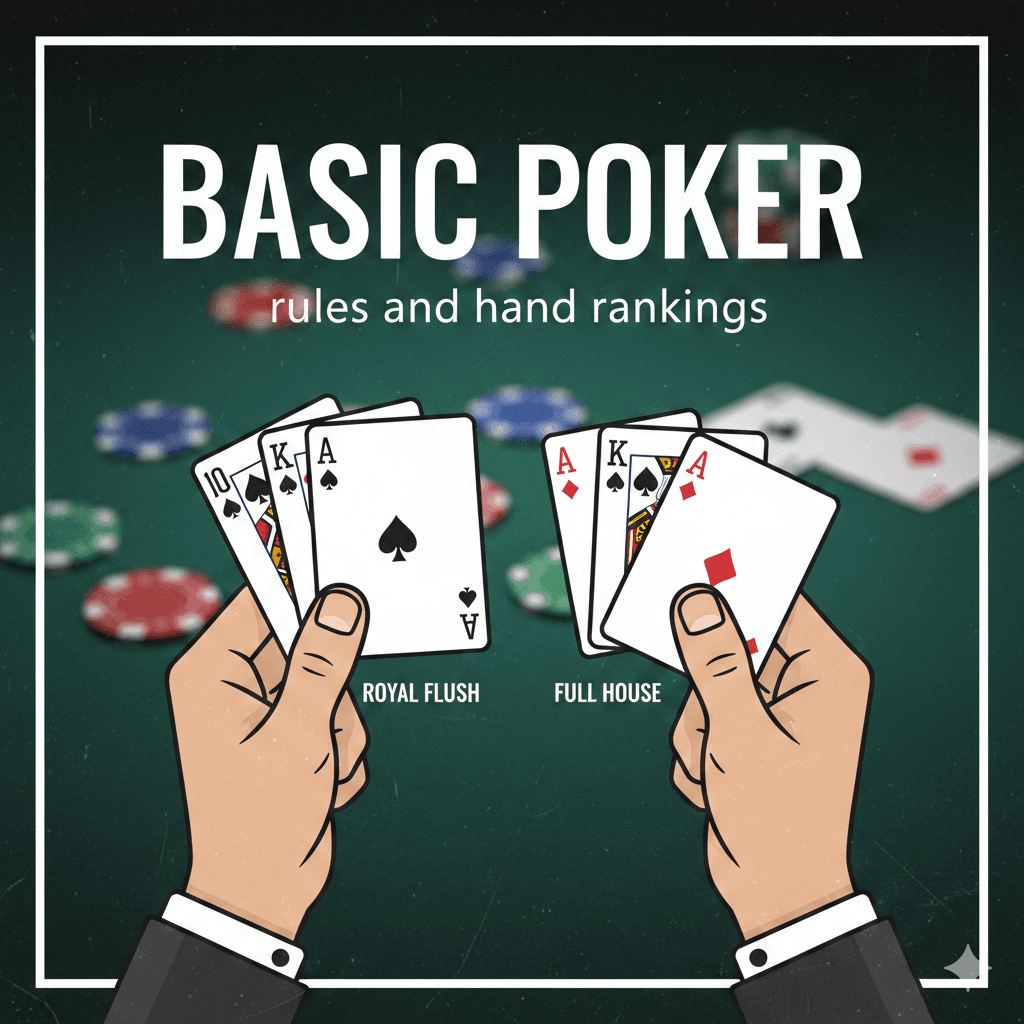
If there’s one card game that’s instantly recognizable, it’s Poker. Even if you don’t play the game, you’ll likely be familiar with it. It’s the number one community game, and it’s a favourite in popular media as well. Whether you’re watching people play on TV, in movies, in tournaments or even in real life, it’s a fact that Poker is one of the world’s most well-loved card games, and one of the most captivating as well.
- What Is Poker?
- The rules of Texas Hold’em Poker
- The order of poker play
- The poker betting options
- To fold or not to fold
- The poker betting rounds
- The pre-flop
- The flop
- The turn
- The river
- The showdown
- Poker hand rankings
- Royal Flush
- Straight Flush
- Four of a Kind
- Full House
- Flush
- Straight
- Three of a Kind
- Two Pair
- One Pair
- High Card
- Points to remember:
- Deal yourself into online Poker today
If you’re a beginner, however, we understand that Poker can seem intimidating at first. You have rules to learn, a strategy to understand, bluffing to master. And other players to face off against. Throw in things like terminology, betting choices, variations and more, and it can all feel a little overwhelming.
The good news? Poker is actually a lot simpler than it appears to be. To get started, all you need are the basics. And an understanding of the way different card hands are ranked. That’s it. Everything else you can pick up along the way.
So if you’ve always wanted to check, call and raise along with the best of them, now’s your chance. Let’s have a look at the fundamentals of Poker together, and let’s get you dealt into the game!
What Is Poker?
Before we get into the rules of Poker, it might be helpful to understand exactly what the game involves.
At its heart, the objective of Poker is simple: to make the best five-card hand possible from a combination of your cards and shared community cards. Of course, that’s the most basic version of the game (and the one we’ll be focusing on). But add in elements like strategy, skill and psychology, and it can become a much more complex and challenging game. Both to play and to watch as well.
That’s because unlike straightforward table games such as Roulette or Blackjack, in Poker you’ll be going up against other players, which means decision-making plays an important role. The more experience you have, the better decisions you’ll be able to make, which will ultimately affect your outcomes in the game.
For now though, we’re just going to focus on the fundamentals of Poker to get you started, more specifically, the rules of Texas Hold’em. As one of the most popular variations of Poker both in real life and online, it’s the form of Poker you’re most likely to come across. Knowing how to play will help you feel comfortable and confident in your betting choices. Which is the first step to success.
The rules of Texas Hold’em Poker
As we’ve already stated, the objective of Poker is to create the best five-card hand possible from the options given to you. In Texas Hold’em, that means using:
- The two private cards dealt to you at the beginning of the game (called hole cards), and
- The five community cards are face-up in the middle of the table
That gives you a total of seven cards to help you build the best five-card hand you can. Use both of your hole cards, use none at all, it’s completely your choice. Just make sure that your final hand consists of five cards, and you’ll be in with a chance.
The order of poker play
If you’re someone who thrives on organization and routine, you’ll love how orderly Poker is, with each round following a carefully structured sequence.
To start with, two players each place forced bets, known as ‘blinds’. In Texas Hold’em, these are categorized as the Small Blind and the Big Blind. These bets are made by the players to the left of the button. A piece on the table that marks the dealer position for the round.
Why the forced bets? Because these make up the starting pot. Without them, there would be nothing to play for, and no incentive for any other players to make bets. The more bets increase after the posting of the blinds, the bigger the pot becomes.
At the beginning of each new round, the dealer button rotates one space to the left, with the Small Blind and the Big Blind positions moving as well. In this way, the posting of the blinds is fairly distributed across all games.
Once the blind bets have been placed, the cards are dealt. Each player receives two private cards, which only they can see. Based on the strength of these cards, players will then place their initial bets, with betting moving clockwise around the table.
The poker betting options
It’s time to place your first bet! In Poker, you’ll have a number of betting options available to you during each round – it’s up to you to choose the one that you think works best for your Poker hand and your strategy. When the betting comes to you, you’ll need to decide whether you want to:
- Check: This is an option that’ll be open to you if no one else has placed a bet in the round yet. Essentially, you’re saying you don’t want to bet yet, but you also don’t want to leave the game. So the action will move to the next player automatically. If everyone checks, the betting round is complete, and the next stage of the game begins.
- Bet: No one else put any chips in the pot yet? Then you’ll be able to bet, if you think that’s the best move. Similar to a check in that a bet can only be placed if no other players have bet yet, a bet involves you literally placing a wager. Thereby setting the price of betting for the round. Once you’ve placed your bet, players can then decide to either match your bet (call), increase the bet (raise), or leave the game (fold).
To fold or not to fold
- Fold: If you’re not happy with your cards, or the play is a little too rich for your blood, you can choose to fold your hand and exit the game. You’ll still be able to view all the action, you just won’t be able to make any moves of your own. Remember – folding isn’t a weak move. It’s all about you protecting your bankroll, which is the strongest play there is.
- Call: If you call, it means that you’re matching the current highest bet on the table. So if someone’s just bet $10, you’ll call by placing your own $10 bet. This allows you to stay in the game while managing your finances too. It’s a balanced play, and one that doesn’t incur too much risk.
- Raise: This is the iconic Poker move. In movies, it’s “I’ll see you, and I’ll raise you.” Just so you know the character means business! In real life, raising means increasing the bet – so if you were to take our previous example, you’d match the $10 bet, then add more on top of that, for example, another $10. So the value of the bet is now $20.
Once you’ve raised the stakes, the other players will now need to either match that same bet (call), re-raise the bet to an even higher amount, or fold their hand. In this way, you can put pressure on the game. A strategic move that literally ups the stakes.
The poker betting rounds
Ok, so now you know the order of play and the various betting options available to you. Now the community cards are dealt, the game moves forward, and you start building your five-card hand.
There are four betting rounds in Poker, one for each stage of the game. Each stage has a different name and a different purpose, so the sooner you learn which is which, the sooner you’ll be able to start gaining valuable Poker experience.
The pre-flop
First up is the pre-flop – the round that begins as soon as all players have received their two private cards (hole cards), and before any of the community cards are dealt.
The player to the left of the Big Blind is the one who’ll begin the round, either matching the amount of the Big Blind (call), or increasing the bet (raise). In this case, the raise needs to be at least twice the amount of the Big Blind to qualify. Or the player can choose to fold their cards and leave the game. Their decision entirely.
Once the first player has made their choice, the action moves to the next player on the left. Who has the same betting options to choose from, and the same decisions to make.
The flop
After the pre-flop comes the flop – the stage where three community cards are dealt in the middle of the table. The first card on the top of the deck is ‘burned’, or removed, and the next three cards in the deck are dealt as the flop. This is your first chance to begin forming your five-card Poker hand.
You’ll have the same betting options as you did in the pre-flop (call, raise, fold) although now you’ll have the ability to check as well – to pass the action onto the next player without making a bet yourself, provided no one else in the round has placed a bet.
Not sure of which betting decision to make? Look at your hole cards, look at the community cards, and see which type of Poker hand you can create from both. If it’s a high-value hand, you’ll want to move forward. If not, you might want to either leave the game. Or wait a while and see if your chances improve in the following betting rounds.
The turn
Once the flop has come to an end, the turn begins. The round where the fourth community card is dealt. Again, you and the other players will have the opportunity to check, bet, call, raise or fold.
The river
In the fourth betting round of Texas Hold’em, known as the river, the fifth and final community card is dealt, and the last round of betting commences. Players will have a final opportunity to check, call, bet, raise or fold. And because it’s the final round of betting, this is where the biggest psychological battles usually take place.
If there’s more than one player left in the game after the final round of betting, then the game proceeds to a showdown – which is often just as intense as it sounds!
The showdown
This is the make-or-break moment. The point at which the last bet or raise has been called. And the players still in the game need to show or declare their hands. Usually this is done in order around the table, rather than all at the same time.
Once all the hands have been displayed, the player with the highest value hand will be declared the winner. If two players have the same hand, the pot can be shared in some scenarios, depending on the particular rules of the game, and the ranking of the players’ hands against their opponents. It’s also worth mentioning that if only one player is left in the game after the final round of betting, they will win the pot automatically, making the showdown unnecessary.
Poker hand rankings
So, ready to get in the game and show your stuff? Just one thing first — you need to know how the different poker hands rank so you can build the best one possible. This is by far the most important information you’ll need as a Poker player, so if you only take one thing away from this guide, let it be this!
Here’s a breakdown of the value of the various hands available in Poker, ranked from highest to lowest.
Royal Flush
What it is: This is the number one hand in Poker. The absolute strongest hand you can possibly have, that beats everything. A Royal Flush is an A, K, Q, J and 10, all of the same suit. It’s incredibly exciting, and incredibly rare as well.
What it looks like: A♠ K♠ Q♠ J♠ 10♠
What it beats: Literally everything. It’s the most unbeatable hand in Poker, and the ultimate flex.
What happens if there’s a tie: It’s not even possible to have two Royal Flushes in Texas Hold’em due to the inclusion of community cards, so don’t even worry about this.
Straight Flush
What it is: Five consecutive cards of the same suit.
What it looks like: 9♦ 8♦ 7♦ 6♦ 5♦
What it beats: Everything except for a Royal Flush.
What happens in a tie? This is impossible for a Royal Flush in Texas Hold’em, but with a Straight Flush, it could happen. If it does, the player with the highest value top card wins – so 9♦ 8♦ 7♦ 6♦ 5♦ would rank higher than 7♠ 6♠ 5♠ 4♠ 3♠.
Four of a Kind
What it is: Exactly what it sounds like – four cards of identical rank.
What it looks like: K♣ K♦ K♠ K♥ 3♣
What it beats: Everything from a Full House down.
What happens if there’s a tie: As you might imagine, the highest value Four-of-a-Kind wins – so K♣ K♦ K♠ K♥ 3♣ would win over 7♠ 7♠ 7♠ 4♥. If two players have the same Four-of-a-Kind hand, the player with the higher kicker (additional card in the hand) wins.
Full House
What it is: This is essentially two hands in one – a Three-of-a-Kind plus a pair.
What it looks like: Q♠ Q♦ Q♣ 7♥ 7♦
What it beats: Everything from a Flush down.
What happens if there’s a tie: If two players reveal Full Houses at the showdown, the hand with the highest Three-of-a-Kind wins. If both Three-of-a-Kinds are again identical, the player with the highest pair wins.
Flush
What it is: A hand of five cards of the same suit, not necessarily in sequence.
What it looks like: A♥ J♥ 9♥ 6♥ 3♥
What it beats: Everything from a Straight down.
What happens if there’s a tie: If two players both have Flushes, the highest card wins. If these are identical, then the win moves to the second-highest card, all the way down to the fifth-highest card if needed. If all five cards are of identical rank between both hands, then the pot is split.
Straight
What it is: Five consecutive cards, not necessarily of the same suit.
What it looks like: 10♠ 9♦ 8♣ 7♥ 6♦
What it beats: Everything from a Three-of-a-Kind down.
What happens if there’s a tie: If two Three-of-a-Kind hands are present at the showdown, the one with the highest top card wins. Note that Aces can be both high (A-K-Q-J-10) or low (A-2-3-4-5).
Three of a Kind
What it is: Three cards of identical rank.
What it looks like: 8♠ 8♦ 8♣ K♠ 2♥
What it beats: Everything from Two Pair down.
What happens if there’s a tie: In this case, the highest Three-of-a-Kind hand wins. If both hands are identical, the hand with the highest kicker wins. This can go down to the second kicker, if both the first kickers are identical as well.
Two Pair
What it is: A hand with two different pairs of cards.
What it looks like: J♠ J♦ 4♣ 4♥ 9♦
What it beats: One Pair, and a High Card.
What happens if there’s a tie: In a tie between two Two Pair hands, the hand with the highest pair wins. If these are identical, the second-highest pair wins. Again, if both second pairs match, then the highest kicker wins.
One Pair
What it is: Two cards of identical rank.
What it looks like: A♠ A♦ 7♣ 5♥ 3♠
What it beats: High Card.
What happens if there’s a tie: Compare both hands – the highest pair between the two wins. If the pair is identical, compare the highest kicker, then the second, then the third. The hand with the highest value card wins.
High Card
What it is: If no one has any of the above hands, the win goes to the player with the highest single card.
What it looks like: A♣ 10♦ 7♠ 5♥ 2♣
What it beats: A High Card hand can only beat another High Card hand.
What happens if there’s a tie: As the name suggests, the highest card wins. If necessary, this extends down to the fifth card to determine the winner.
Points to remember:
- Poker hands rank from highest to lowest. The harder a hand is to build, the higher it will rank – hence a Royal Flush being worth far more than a High Card.
- Not enthused by the value of your hole cards? Wait until the community cards are dealt — Texas Hold’em gives you plenty of opportunities to build the strongest hand possible.
- While individual cards are worth more or less depending on their face value, remember that all suits are ranked equally. Spades are not higher than hearts; diamonds are not higher than clubs. All suits are equal.
- Don’t count out the kicker. Often winning comes down to the kicker, and it’s here where the value of a hand can lie. The higher your kicker, the better your winning chances in the event of a tie.
- Remember, Aces are unique in that they can be both high and low – which gives them added value in a straight. They’re your secret weapon, so use them wisely!
Deal yourself into online Poker today
So, now that we’ve taken you through the basics of Poker, how do you feel about the game? Still a little overwhelmed by it all, or maybe a touch more confident in your ability to get through a game?
Just remember that while Poker might seem complex, at its heart it’s a game that’s built on simplicity and structure. As long as you know the fundamental rules, the betting options available to you, and the card hand rankings. You’ll have everything you need as a beginner to start placing your bets. Looking forward to seeing you at the tables soon!