

The Definitive Guide to Poker Table Positions and Professional Etiquette

Ask any experienced poker player, and they will tell you the same thing: poker is not just about the luck of the draw. It is a game of skill, math, information, and discipline.
- Understanding the Fundamentals of Poker Table Position
- Why Position Is So Important in Poker Strategy
- The Anatomy of a Poker Table: 6-Max vs. Full Ring
- 6-Max vs. Full Ring at a Glance
- Detailed Breakdown of Positional Groups in Poker
- Early Position (EP): Under the Gun (UTG) and UTG+1
- Middle Position (MP): The LoJack and HiJack
- Late Position (LP): The Cutoff (CO) and the Button (BTN)
- The Blinds: Small Blind (SB) and Big Blind (BB)
- Poker Positions at a Glance
- Strategic Impact of Position on Hand Selection
- Defining Positional Ranges: Tight vs. Wide
- Positional Awareness in Post-Flop Play
- Poker Etiquette: The Unwritten Rules
- Core Principles of Live Table Conduct
- Technical Violations and Angle Shooting
- Social Etiquette and Player Interaction
- Modern Adaptations: Online Poker Etiquette
- Managing the Digital Pace of Play
- Online Chat Box Decorum and Sportsmanship
- Integrating Position and Protocol for Success in Poker
That discipline starts with something many casual players underestimate: where you sit. In poker, position is one of the most important strategic variables in the game. It affects what hands you should play, how aggressively you can play them, and how much information you have before making a decision.
Just as important, though often overlooked, is etiquette. If you want to play well in live or online poker, you need to understand not only strategy, but also the unwritten rules that keep the game fair, efficient, and respectful.
In poker, your seat affects your strategy almost as much as your cards do.
Understanding the Fundamentals of Poker Table Position
Position is the silent engine of Texas Hold’em. While the goal of the game is to win pots either by making the best five-card hand or by forcing everyone else to fold, your seat at the table plays a major role in how costly that pursuit becomes.
In a standard game, the objective is not just winning individual hands. It is making mathematically sound decisions that maximize your long-term gain over hundreds or thousands of hands.
Why Position Is So Important in Poker Strategy
Position is essentially an information advantage built into the structure of the game. In Hold’em, the dealer button rotates clockwise, which constantly changes who acts first and who acts last. Acting later in the betting order gives you more information before you have to commit chips.
The strategic benefits of position include:
- Information advantage: Acting after your opponents allows you to see their checks, bets, or raises before making your decision.
- Bluffing efficiency: Position makes bluffs cheaper and more effective because you already know whether your opponents have shown strength.
- Pot control: Acting last gives you greater control over whether the pot stays small or grows.
- Post-flop flexibility: Position makes it easier to take free cards, value bet thinly, or pressure weaker ranges.
As the number of players at the table increases, the value of position becomes even more significant. More players mean more unknowns acting before you.
The Anatomy of a Poker Table: 6-Max vs. Full Ring
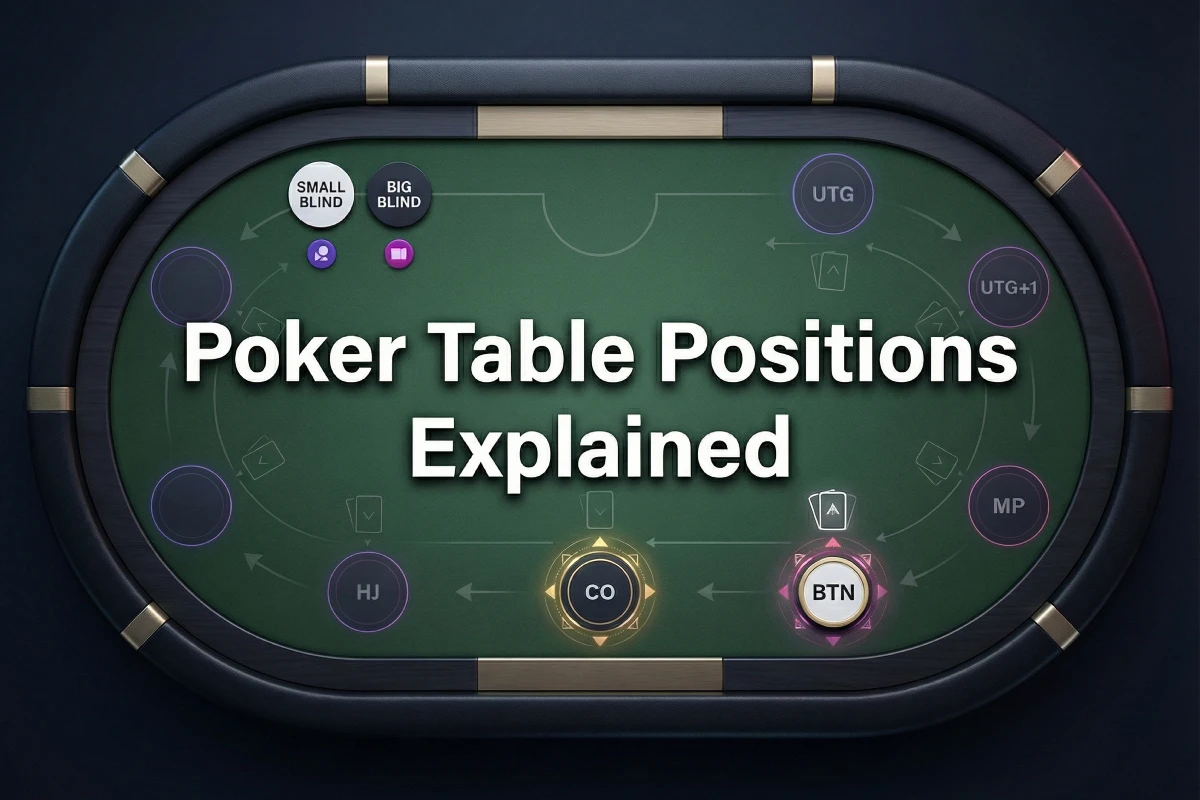
Whether you are playing a 6-max online game or a 9-handed full-ring live game, the geometry of the table remains the same. Everything revolves around the dealer button.
The key components of the table include:
- The Dealer Button (BTN): The player on the button acts last in most post-flop situations, making it the most advantageous position at the table.
- Clockwise Rotation: After each hand, the button moves one seat to the left so that positional advantages and forced bets are shared over time.
- The Blinds: The Small Blind (SB) sits immediately to the left of the button, and the Big Blind (BB) sits to the left of the Small Blind.
In a 6-max game, the action is faster and ranges are generally wider because the blinds hit more often. In a full-ring game, players can afford to be more selective, especially in early position.
6-Max vs. Full Ring at a Glance
| Format | Typical Players | General Style | Positional Effect |
| 6-Max | 6 | Faster, more aggressive, wider ranges | Late position remains powerful, but blinds come around faster |
| Full Ring | 8 to 10 | Slower, tighter, more selective pre-flop | Early position becomes more restrictive because more players remain to act |
Detailed Breakdown of Positional Groups in Poker
In a standard game, understanding where you sit in the rotation is the difference between bleeding chips and making disciplined decisions. As the number of players grows, you generally need to fold more often and enter pots with stronger hands.
Early Position (EP): Under the Gun (UTG) and UTG+1
Sitting under the gun is as uncomfortable as it sounds. You are first to act pre-flop and have no information on what the remaining players intend to do.
The main constraints of early position include:
- Survival first: Because so many players act after you, the chance that someone holds a stronger hand is relatively high.
- Tighter ranges: You should generally enter the pot with your strongest holdings.
- Post-flop vulnerability: Even if you continue, you are often out of position for the rest of the hand.
Early position demands discipline. If you act first, you generally need a hand that can stand pressure from the players behind you.
Middle Position (MP): The LoJack and HiJack
As the action moves clockwise, you gain some breathing room. A few players have already acted, which reduces the number of unknowns still left in the hand.
Middle position allows for a slightly wider approach:
- More speculative hands: You can begin to include some medium pairs and suited hands with drawing potential.
- More initiative: This is often a better spot to raise than to call, especially if the players behind you are aggressive.
- More information: You can use what earlier players have done to shape your decisions.
Late Position (LP): The Cutoff (CO) and the Button (BTN)
Late position is where poker becomes most flexible. The button in particular is often called the power seat because you act last on every post-flop street.
The benefits of late position include:
- Acting last: You get the most information before making your decision.
- Stealing blinds: Since fewer players remain to act, you can open with a wider range and pressure the blinds.
- Realizing equity: You can often check behind and see another card for free when appropriate.
The Blinds: Small Blind (SB) and Big Blind (BB)
The blinds are forced bets that create action, but they also place players in awkward spots.
The challenges of playing from the blinds include:
- Forced contributions: You already have money in the pot before seeing your cards.
- Out-of-position play: After the flop, you usually have to act before the players in late position.
- Defending pressure: The Big Blind in particular is often forced into difficult decisions because of pot odds and wide opening ranges from late position.
Poker Positions at a Glance
| Position Group | Examples | Typical Style | General Difficulty |
| Early Position | UTG, UTG+1 | Tight and selective | High |
| Middle Position | LoJack, HiJack | Balanced, slightly wider | Moderate |
| Late Position | Cutoff, Button | Aggressive, widest ranges | Lower with skill advantage |
| Blinds | Small Blind, Big Blind | Defensive and difficult | High |
Strategic Impact of Position on Hand Selection
Most beginners play their cards. Stronger players play both their cards and their seat.
A hand’s value changes depending on how many players remain to act. A hand that may be worth opening on the button can become a fold from under the gun simply because too many players can still wake up with something better.
Defining Positional Ranges: Tight vs. Wide
The concept of a range is simply the set of hands a player is likely to hold or play from a given position.
As you move clockwise around the table, your opening range should generally expand. In early position, ranges stay tight because there are many players left to act. In late position, ranges widen because fewer unknowns remain.
A common progression looks like this:
- UTG: Stronger pairs, strong broadways, and premium aces.
- Middle Position: Slightly wider range including more medium pairs and playable suited hands.
- Cutoff: Wider opening range because only a few players remain.
- Button: Widest opening range, especially when the blinds are passive.
Positional Awareness in Post-Flop Play
Winning pots pre-flop is valuable, but much of the game is decided after the flop. This is where position becomes even more important.
The major tactical benefits of acting last post-flop include:
- Seeing checks first: If opponents check to you, you can decide whether to bet for value, bluff, or take a free card.
- Realizing equity: With draws, acting last can allow you to see additional cards without paying extra.
- Representing strength: Position gives you more ways to credibly tell the story of a strong hand.
Position is not just about acting last pre-flop. Its biggest value often appears after the flop, when every extra piece of information matters.
Poker Etiquette: The Unwritten Rules
If you want to be taken seriously in a card room, you need more than technical skill. Poker also runs on etiquette. Good conduct keeps the game fair, fast, and enjoyable for everyone at the table.
Core Principles of Live Table Conduct
The flow of a live game depends on players acting predictably and respectfully. The most important rules include:
- Acting in turn: Do not fold, call, or raise before the action reaches you.
- Protecting your hand: Keep your cards identifiable so they are not accidentally mucked.
- Clear communication: If you want to raise, say so clearly before moving chips.
- One player to a hand: Do not comment on live action if you are not in the hand.
Technical Violations and Angle Shooting
Some mistakes are innocent, while others are seen as attempts to gain an unfair edge.
Common violations include:
- String betting: Putting chips in the pot in multiple motions without clearly declaring a raise.
- Splashing the pot: Tossing chips into the center so the amount becomes hard to verify.
- Slow-rolling: Deliberately delaying the reveal of a winning hand at showdown.
Even when something is technically allowed, if it is designed to mislead or manipulate the table, it will usually damage your reputation quickly.
Social Etiquette and Player Interaction
Poker is competitive, but it is still a social game. Good table manners matter.
- Respect the dealer: The dealer is there to run the game, not absorb frustration from bad beats.
- Manage tilt calmly: Losing is part of poker. Throwing cards or making a scene is not.
- Avoid unnecessary commentary: Do not analyze hands in progress or lecture other players.
In poker, reputation matters. A player known for poor etiquette often loses more than respect.
Modern Adaptations: Online Poker Etiquette
Online poker changes the environment, but not the need for professionalism. The lack of physical presence can make players forget that etiquette still matters.
Managing the Digital Pace of Play
Online games move faster than live ones, which makes timing and responsiveness more important.
- Avoid stalling: Do not abuse the time bank on routine decisions.
- Sit out properly: If you need a break, sit out rather than timing out repeatedly.
- Use pre-select options responsibly: If you already know your action, using check/fold tools keeps the game moving.
Online Chat Box Decorum and Sportsmanship
The chat box should not become a distraction or a place for abuse.
- Do not discuss active hands: Even small comments can influence ongoing action.
- Do not berate weaker players: Criticizing bad play only hurts the atmosphere and can reduce your long-term edge.
- Keep communication polite: Brief, neutral sportsmanship goes much further than emotional outbursts.
Integrating Position and Protocol for Success in Poker
Mastering poker’s invisible elements, where you sit and how you behave, is what separates disciplined players from casual tourists.
You can understand the math of the game, but if you are playing weak hands from early position or damaging your reputation through poor conduct, you are making the game harder than it needs to be.
The core of a strong poker approach includes:
- Positional discipline: Recognizing that your seat should influence your strategy.
- Ethical play: Avoiding technical violations and angle-shooting behavior.
- Emotional control: Managing the inevitable swings of poker without losing composure.
Respect the table, understand the logic of position, and make decisions that hold up over the long run.