

 Online Casino
 Promotions
 Bonuses
 Academy
 Tools
Tools News
News Community
 Account
 Login
Login Free Spins
 Free Chips
 Sweeps
The psychology of “just one more game” when gambling online

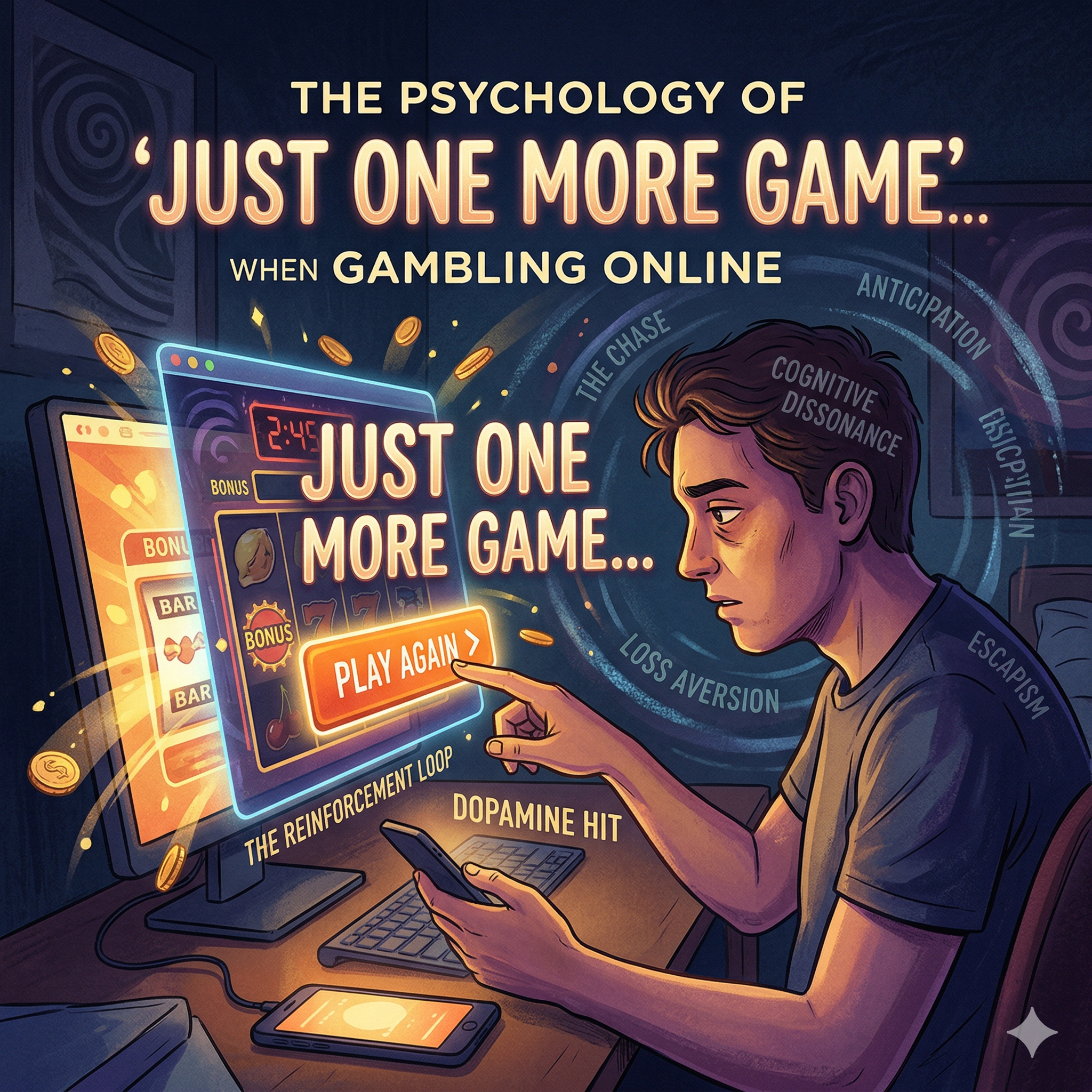
We’ve all been there. You have a few minutes to spare so you think, why not log onto the casino for a bit? There’s just enough time for a couple of spins, maybe a hand of cards or two, and that’s it. You have a limit on the amount of time you can play for and you’re completely in control. But the psychology behind one more game gets you.
- The psychology – illusion of control
- The psychology – power of the near miss
- Chasing the turning point – The psychology behind it
- The passage of time online
- What if you have no physical chips?
- Emotions and gambling
- Is one more game always a bad thing?
- How to break the “one more game” cycle
- Break frequently to ensure optimal performance
- Keep a clear head and keep having fun
Until you’re not. And the worst part is it starts so innocently. You think to yourself, ok, I’m having fun, let me play just one more game. Or you’ve just lost, so you think, how about another round quickly just to see if I can win it back?
Then before you know it, hours have passed, you’ve missed whatever appointment you had or task you needed to complete. And your bankroll has been decimated. Oops. All because you wanted to play “just one more game”.
We get it. Gambling is hugely engaging, and when you’re in the zone, win or lose, it’s hard to walk away. But why is it so difficult to limit your gambling, even when you know that you absolutely should? Let’s take a look.
The psychology – illusion of control
You know how you thought you were in control when you started your session? Spoiler alert: you weren’t as on top of things as you thought. That’s because one of the key psychological factors at play when you play is the feeling that you can somehow influence the outcome. And it’s this idea (or hope) that keeps you playing long past the point of reason.
No matter how much you understand logically that the RNG is in charge, and that every outcome is independent from the one before, you still can’t stop that little voice in your head from whispering to you: “You almost had that!” or “Don’t worry, this machine is about to pay out anytime now!”.
Motivation and positivity are good. Feeling in control of your circumstances is also good. But when you’re in an environment that’s built on the concepts of luck, chance and randomness, it’s important to understand that there’s no way for you to influence the outcome. The only control you have is over your decisions and your bankroll.
So that’s where you need to focus your efforts. Don’t give into the voice that promises you’ll win with your next bet. Instead, concentrate on what you can control, and manage your decision-making and your finances as closely as possible.
The psychology – power of the near miss
Don’t you hate how when you’re playing slots, you ALMOST get a winning combination? All the symbols you need are RIGHT THERE, except for just one. It’s a hugely motivating feeling – you CAN do this, and if you carry on playing, you’re bound to eventually get that combo that you need, right?
That’s the power of the near miss. An outcome that, while technically a loss, feels different from other complete misses. You were ALMOST there. And that win is so close you can feel it.
It’s this spark of hope and anticipation that keeps you playing long after you should have ended your session. And it’s what can cause significant damage to your bankroll as a result.
Don’t fall prey to this idea, no matter how tempting it seems. Everything is random, everything is based on luck. And you’re just as likely to get no matches with your next spin as you are to get a jackpot. So make sure to always play it safe.
Chasing the turning point – The psychology behind it
Ever hear of the concept of ‘turning point’? In a gambling context, it’s the psychology point at which you believe the game is about to turn in your favour.
In theory, there’s nothing wrong with this, but that’s the problem to begin with – the turning point is simply a theory, and not grounded in any kind of science or fact. Which is why you start to think things like:
- “I’ll stop playing as soon as I finally win a game”, or
- “I’ll stop playing once I’ve won a certain amount.
In the first scenario, you’re waiting for your luck to turn from a loss to a win. In the second, you’re waiting for small wins to turn into even bigger ones. The difficulty is that while both feel as if they’ll have positive outcomes for you, neither one is based on any concrete evidence.
What’s more, the longer you play, the more the goal posts start to move, and the further away the turning point becomes. If you win, your ultimate profit goal becomes higher and higher. If you lose, your urge to recover your losses becomes stronger and stronger. And eventually, your fortunes do turn – just not in the way you’d like.
Rather than chasing an ever-elusive turning point that becomes more flexible the longer you play, set firm limits on your gambling instead. Either in terms of how much you win or lose, or how long you play for. The stricter your boundaries are, the more your bankroll will benefit.
The passage of time online
Ever notice how quickly time seems to pass when you’re online? You sit down to look at social media for a few minutes and the next thing you know, you’ve been doomscrolling TikTok for two hours.
It’s the same with online gambling – if you’re not careful, you could spend far longer gambling online than you originally planned. Which means more money spent, and usually more money lost as well.
Why? Well, we can’t speak to the social media phenomenon (although we think it’s about instant gratification), but as far as gambling goes, it’s because the casino environment is designed to be smooth, streamlined and continuous – to have as few breaks and glitches as possible to ensure an uninterrupted stream of entertainment.
What if you have no physical chips?
Think about it. The psychology says there are no physical chips that need handling, no breaks between rounds as the croupiers prepare for the next game, and no external cues for you to leave, like feeling tired or hungry, or your friends wanting to go. Instead, it’s just you and the casino, game after game, with premium convenience and accessibility built right in.
So if you’re not fully present in the moment and completely in control of your gaming behaviour, you could end up losing track of time. Which is why a session that you only planned on playing for 20 minutes could turn into a two-hour gambling marathon.
What’s the solution then? Quite simply, awareness. Being aware of your surroundings, of how many games you play, how many bets you place, and how much money you spend. Set a timer if you have to, to keep track of how long you’re playing for. Any tips or hacks you need to keep a handle on how long you’re gambling for? Time moves differently in online casinos – make sure you’re aware of every minute. And aware of the psychology behind your behaviours.
Emotions and gambling
As much as we always try to tell you to leave emotion out of your gambling, the fact is we’re only human – and as such, sometimes emotion can enter the chat anyway, no matter how strictly we try to guard against it. And when it does, it can play a role in extending a gambling session way past when it should have actually ended.
Think about it. After you lose, you’re frustrated. So you keep on playing in an attempt to turn things around. After a win, you’re excited and pumped full of adrenaline. So you carry on playing to chase that emotional high.
In both cases, you’re using your feelings to drive your decision-making, rather than your logic. The psychology says, this isn’t the way to go. The momentum builds, and after a while, it’s difficult to slow down. So you don’t – you keep on going. You keep on playing, and you keep on doing significant damage to your bankroll.
That’s why, as much as possible, you need to focus on your emotional regulation to ensure you gamble responsibly. Leave emotion out of it, play with your head, and protect your bankroll at all costs.
Is one more game always a bad thing?
It’s a fair question. Obviously, the psychology behind this is, if you’re spending beyond your budget, using money that’s been earmarked for other purposes. And gambling to the point of fatigue and mental strain, then one more game is decidedly NOT a good thing.
But what if you’re simply just enjoying yourself, having fun, playing within your means, and having a positive experience? If you’re still within your limits and you’re fully aware of your actions, then one more game isn’t necessarily a negative thing.
Just make sure you know why you’re playing on. Having fun – good. Feeling pressured – bad. Learn to tell the difference, and you’ll know the right decision to make.
How to break the “one more game” cycle
We’ve given you a few tips along the way, but now it’s time to really get into it. How do you break the cycle of “one more game” and ensure that you’re always playing responsibly?
We don’t want you to remove spontaneity from your gameplay entirely (not everything needs to be relentlessly planned every minute of the day), but we do want you to start developing a few small habits to help you stay in control and play with intention:
- Set a clear end point: Don’t go into your session telling yourself that you’ll stop “whenever”. The psychology of this doesn’t align. Instead, make sure you have a clear endpoint in mind, whether your limits are based on time, budget, or the number of rounds you play. The clearer your boundaries are, the more likely you’ll be to stick to them.
- Take short breaks: A great way of building awareness of your gambling and staying present can be by taking short, regular breaks during your gambling session. Not only will stepping away help to clear your mind and rid you of any emotional momentum, but it’ll also give you the natural breaks in play you need to stay grounded and in the moment.
Break frequently to ensure optimal performance
- Make sure you’re playing for the right reasons: We know you want to carry on playing. Gambling is fun, and it’s no surprise you’d want to keep at it. Ae you actually playing for entertainment, or for something else? Ask yourself (and be honest): “Am I genuinely enjoying my gambling right now, or am I just trying to win money?” If it’s the latter, end your session and walk away.
- Create gaps in your play: Want to stop yourself from carrying on playing automatically for hours on end? Insert small, self-imposed gaps in your play to interrupt the constant stream of gaming. This could involve you staying away from auto-play features and playing manually, taking a few seconds before placing each bet, or physically logging out of one game before starting another, rather than leaving the tab open. Anything you can do to stay present while you gamble will help you stay in control of your decision-making.
- Set a ‘last round’ rule: Instead of drifting out of a session, make a conscious decision as to how you’re going to end your session. For example:
- “I’ll play 5 more spins on this slot, and then I’m done.”
- “I’ll finish after this one last hand of Blackjack, regardless of the outcome.”
- “I’ve got enough left in today’s bankroll for one more bet, then that’s it.”
Having a definitive end in mind will make you much more likely to stick to your predetermined limits when the time comes.
Keep a clear head and keep having fun
It’s one of the most important rules of gambling online. Know when to walk away. Outside of enjoying your gambling and protecting your bankroll, knowing when to end your session is one of the most crucial skills you’ll ever develop as an online casino player.
That’s because while the psychology behind “just one more game” sounds harmless enough (and often is), it can also spiral into significant losses if you’re not careful, making an impact both on your finances and your mental health.
So don’t stay in the game to your own detriment. Make sure you’re enjoying your casino experience, and that you’re playing responsibly at the same time. Get that balance right, and you’ll have cracked the code to successful online gambling!